
Most people think of a nursery as a place where plants grow. What they picture less often is what happens in the months between the growing and the shipping — the unglamorous middle part, where the work is mostly just keeping things alive.
For us, that means cold storage. Every fall, we dig up our bare root stock — fruit trees, nut trees, berry shrubs, and edible perennials — and move them into our root cellar for the winter. Every spring, we pull them back out and ship them. It’s a clean workflow, and after eight years of refining it, it runs well. But it started from almost nothing, built out of necessity and whatever materials were at hand.
The Structure: A Walk-In Freezer Bermed Into a Hillside
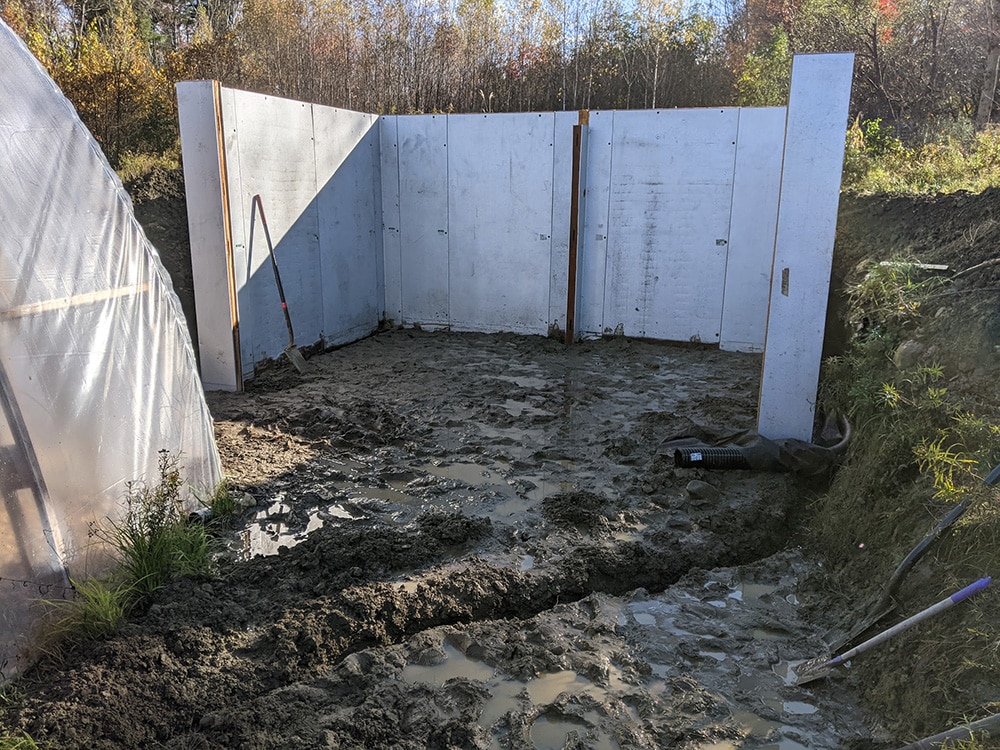
The root cellar itself is a repurposed walk-in freezer — high-density foam panels sandwiched between aluminum sheeting, locking together like large insulated puzzle pieces. It’s the kind of thing you’d normally find inside a restaurant or grocery store. Ours lives outdoors, fully exposed to the elements, bermed into a small hillside so the earth can buffer the temperature through the coldest months.
I’d never seen this done before. It’s certainly not the standard approach, and it may eventually evolve into something larger and more sophisticated. But when I was starting the nursery, I needed to get going, and this was an inexpensive, easy, and effective way to get started that meets all my needs and can store thousands of trees inside.
It’s not fancy. Each fall I throw greenhouse plastic over the top to shed water, and through the winter I shovel snow off the flat roof so the weight doesn’t become a problem. A little sketchy, perhaps — but it has held up remarkably well.
(I dug the site by hand in those early, overly enthusiastic days. If I were doing it again, I’d hire an excavator. Or at minimum, recruit some friends.)
Why Cold Storage Matters for Bare Root Trees
Bare root trees are dormant when they’re dug — their metabolism has slowed, their leaves have dropped, and they’re in a state of suspended readiness, waiting for spring warmth to trigger growth again. The job of winter storage is simply to keep them in that state: cool enough to stay dormant, protected enough that they don’t dry out or freeze hard, and organized enough that spring shipping doesn’t become chaos.
For a small nursery handling many different species, varieties, and sizes, having dedicated cold storage makes an enormous difference. Trees stay clearly labeled and sorted. They’re protected from deer, rodents, and weather. And when spring arrives and orders start going out, everything is ready to move immediately rather than being dug fresh from frozen ground under time pressure.
For anyone storing bare root trees at home — say, you’ve received an order but can’t plant immediately — the simpler version of all this is just heeling in: digging a shallow trench, laying the roots in, covering with moist soil or sawdust, and keeping things out of direct sun and wind. It works well for weeks, sometimes longer. Cold storage is the same principle, just more controlled and scalable.
The Climate Control System: Simple, Low-Energy, Effective
For the first few years, the cellar ran entirely on passive temperature buffering from the earth berm and insulation. This worked reasonably well but left me less control than I wanted, especially during erratic winters with big temperature swings.
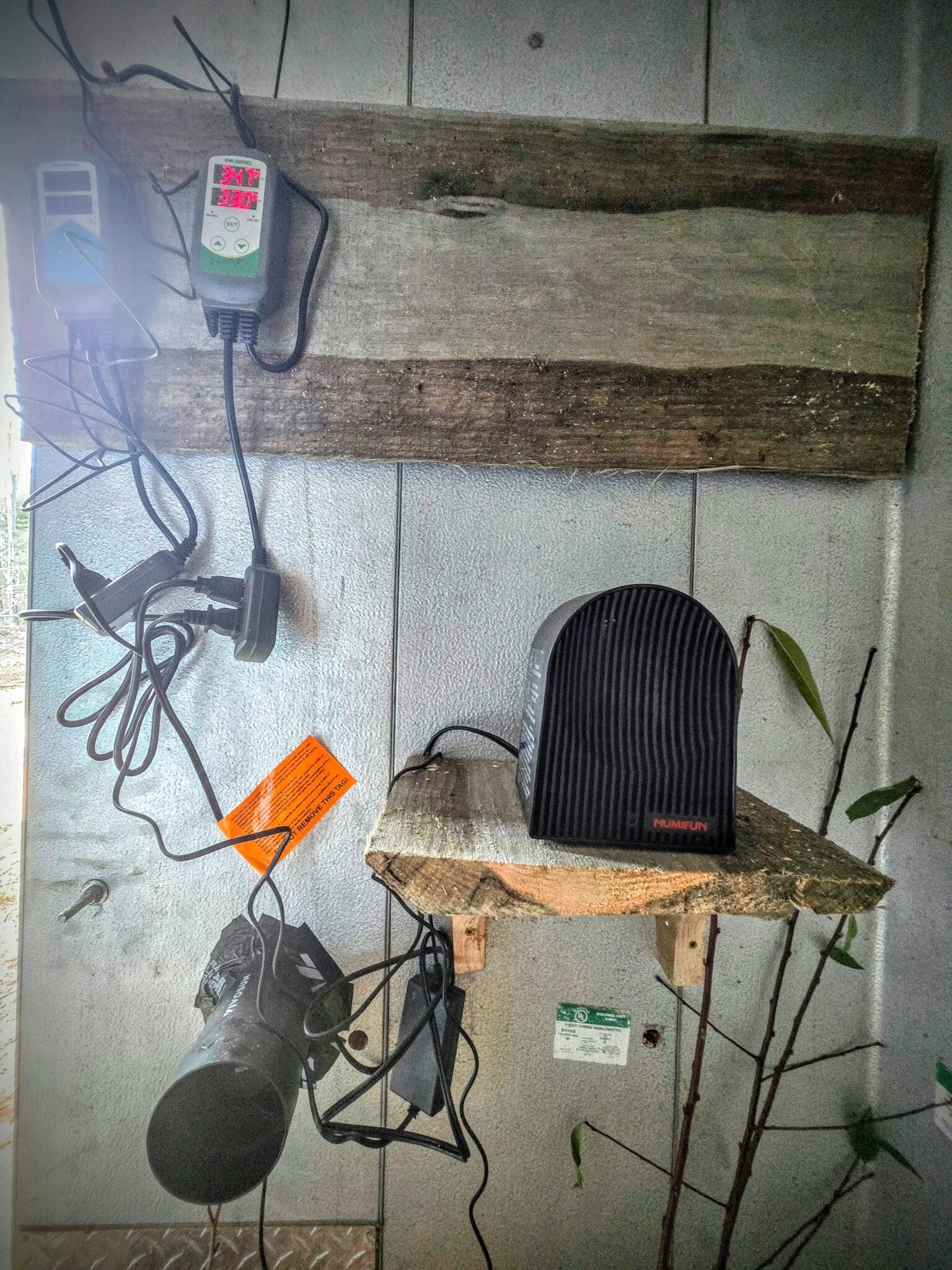
This past fall I made an upgrade. I drilled a 4-inch hole in the wall and installed an inline duct fan on a two-thermostat control system: one thermostat monitors the temperature inside the cellar, the other monitors outside. When it’s colder than 33°F outside and warmer inside, the fan kicks on and pulls cold air in. When conditions don’t call for it, the fan stays off.
It’s wonderfully straightforward. No refrigeration unit, no CoolBot, no compressor — just moving cold air that already exists for free. The energy draw is minimal. The system cost a fraction of what refrigeration would have.
I also added a small electric heater for the coldest stretches — not to keep the cellar warm, but to prevent it from dropping too low during an extended cold snap. Because the structure is well-insulated and bermed in, and because trees are far more forgiving than vegetables in storage, the heater rarely needs to run. It’s insurance more than infrastructure.
The result is a cellar that stays consistently in the 32–36°F range through most of the winter — cold enough to hold dormancy, warm enough to avoid any cold damange. Not quite as precise as a refrigerated unit, but close enough, and at a fraction of the cost and complexity.
What We Store
Beyond our main bare root tree stock — apples, pears, pawpaws, chestnuts, hazelnuts, plums, peaches, and the rest — the cellar doubles as overwintering space for material that needs a bit of extra protection:
Softwood cuttings taken in the fall that need to stay dormant before being potted up in spring. Certain grafts, particularly nut trees, which are less cold-hardy than their eventual mature selves and appreciate protection during their first winter. And borderline-hardy species that we’re trialing — plants that should be fine once established but that we don’t yet fully trust to survive unprotected in their first season.
The cellar has become a kind of liminal space in the nursery’s annual rhythm — where everything waits, quietly, for the right moment to go back into the world.
The Bigger Picture
There’s something I find genuinely satisfying about this system — not because it’s impressive, but because it isn’t. It’s a used walk-in freezer, a hillside, a fan, and two thermostats. It works because the underlying principles are sound: keep things cold, keep them moist, keep them organized. The materials and methods are just in service of that.
I think a lot about this kind of appropriate-scale infrastructure in the context of small farming and nursery work generally. The temptation is always to build for the scale you hope to reach. The wiser move, usually, is to build for the scale you’re at — simply and cheaply — and upgrade from a position of experience rather than unfounded anticipation.
Eight years in, I’m still in the same converted walk-in freezer I bermed into that hillside with a shovel. And it’s working just fine.
We ship bare root edible trees and perennials each spring and fall — fruit trees, nut trees, pawpaws, berry shrubs, and a range of rare and unusual edibles. If you’re curious what’s available this season, take a look here.
