How we grow

Our Site

How we grow is a result of the land and climate we’re working with. Our home and nursery is located in Ashfield, Massachusetts, in zone 5a, at approximately 1400ft elevation. We’re nestled between the agricultural land of the Connecticut river valley to the east, and the more mountainous (by east coast standards anyway) Berkshires to the west. Our soil is deep dense glacial till—the addition of compost has been very important for us in creating a more easily draining, aerated, biologically-active place for our plants to grow. 
Scale

You might be amazed by the number of plants that can grow in a small space with relatively few inputs. Healthy, fertile soil goes a long way. Care, attention, knowledge, and labor to grow the plants is vital as well. But beyond that, there are surprisingly few things required. You can grow thousands of plants in just a quarter acre, or even less than that. You don’t necessarily need expensive heavy machinery. And you certainly don’t need to use poisons or denude the landscape. The regenerative nursery is one of those rare, magical places where what you get out drastically outmeasures what you put in.

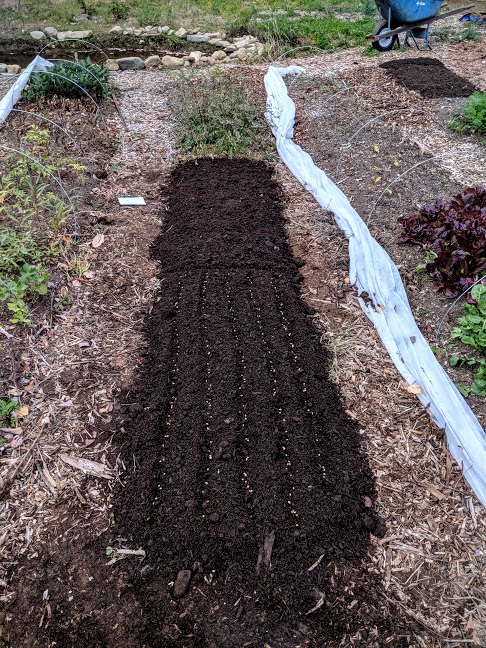
The scale of our nursery is a homestead scale, more like a large intensive garden than the expansive tilled fields you might imagine when you think of a farm. There are strollers, kids toys, buckets strewn about, chickens roaming around eating bugs. We are large enough that our plants can be diverse, affordable, and accessible, and small enough that they can be grown ethically and with care. We believe the homestead-scale nursery produces the finest quality product—vibrant, healthy plants that are given everything they need to thrive.

We want organic, ethically-produced food, so why wouldn’t we want organic, ethically-produced food-bearing trees and shrubs as well? The conventional nursery industry is overflowing with pesticides, herbicides, chemical fertilizer, and disposable plastic. We seek to model what a different kind of nursery can look like, one that creates financial stability for the family, enriches community, and nurtures the landscape while growing plants that can bear food for generations.
Pots vs. Bare Root

We grow plants in the ground and sell them bare root. If you place an order online your plants will arrive dormant with their roots wrapped in a plastic bag with some of aged sawdust to keep them moist. This offers many benefits—unsurprisingly the ground is a much more natural and hospitable place than a pot for a plant to grow, so they are usually healthier and less expensive to produce, require less plastic, less irrigation, less peat, less fertilizer, less moving of heavy objects, and honestly they’re just more fun for me to grow—it just feels like gardening. Potted plants are a bit sexier, perhaps, as they have leaves, and could even be in bloom or fruiting, and they certainly have their place—for a landscaper installing a garden for a client in the middle of summer, for example. But for someone who wants to grow their own perennial food plants, bare root is where it’s at!

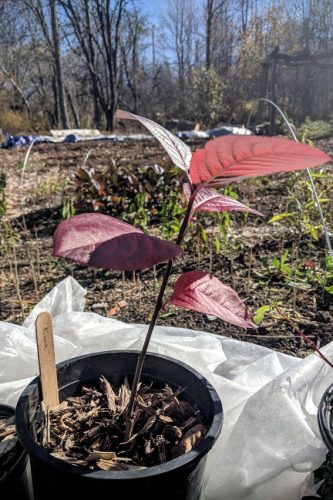
potted aronia
Potted Aronia

Pros: Potted plants can be planted at any time of the growing season without major transplant shock. 

Cons: They’re much more labor and resource intensive to grow and are more expensive. Roots to become dry easily without consistent irrigation, are more vulnerable to temperature fluctuations, etc. If plants aren’t potted on into larger pots as they grow, they quickly become unhealthy, especially in an organic system.

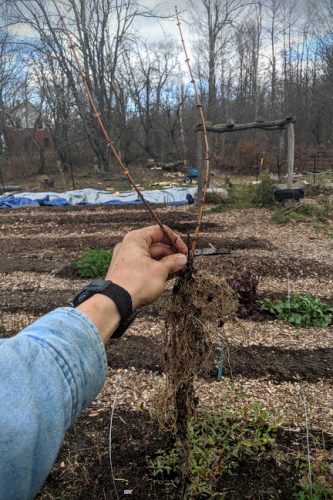
one year bare root honeyberry
Bare-rooted Honeyberry

Pros: Bare root trees can be grown closer together, letting roots overlap and stretch freely, in a more natural substrate, aka the ground. They are also much easier and cheaper to transport over long distances.

Cons: There is a narrow window for harvesting and planting bare root trees when the trees have gone dormant but the ground has not yet frozen. Where we are in Western Mass (zone 5), this is roughly in April and November. They also have to be dug up, which takes a fair amount of labor.

Propagation

It may come as a surprise to you, but many nurseries do not propagate their own plants. They buy them from other nurseries and then resell them immediately or grow them to a larger size before selling them. In contrast, almost all our plants are propagated in-house, and this has many benefits for us. First of all, it’s free, requiring only labor and knowledge, which aligns with our inclination to remove costly inputs when possible. Second, it allows for much greater control of our product—we can make sure our stock material is healthy and our plants are treated with care. And third, it’s just plain fun. I enjoy doing it, so the added labor does not feel like work. It is pure magic to raise a tree from an embryo.

We propagate our plants using seed, cuttings, layering, and grafting. On the next page, you can learn more about how we propagate our plants, and how you can propagate them too.

Free Shipping on Orders over $225

X
Join Waitlist We will inform you when the product arrives in stock. Please leave your valid email address below.
0